
Like any other original creation, products are developed to satisfy a need or a problem statement. This need or problem statement may be something that consumers encounter in their day-to-day activities, or it may be something that they are unable to notice because of the constraints imposed by their culture and the way they live their lives

When you look at the lifespan of any product, you will notice that it follows the human life cycle: a time to be born, a time to thrive, a time to refrain from blossoming, and a time to die, as described clearly in the book of Ecclesiastes. You will agree with me that two things are unavoidable: life and death. When these two elements have been carefully considered, it typically guides the product’s creators by addressing the fundamental question: how fast do you want your product to fail or die?
A Time to Born
It does not matter how soon or how late a product is created; it can be now or later. There is no latecomer for the right product in the race to create innovative brands. It is a statement of “Your time starts now,” which is dependent on the creator. However, one thing sits at the epicenter, the isoelectric point, of your innovation, and that is the consumer (the king).
As King Henry IV said, “Uneasy lies the head that wears the crown’ and the other popular saying, “A king has no friends but foes and followers”. As political as these statements may sound, they have stood the test of time and proven true. Consumers, the king, are daily confronted with choices that are time-bound and influenced by factors within and outside of their control.
A Time to Die
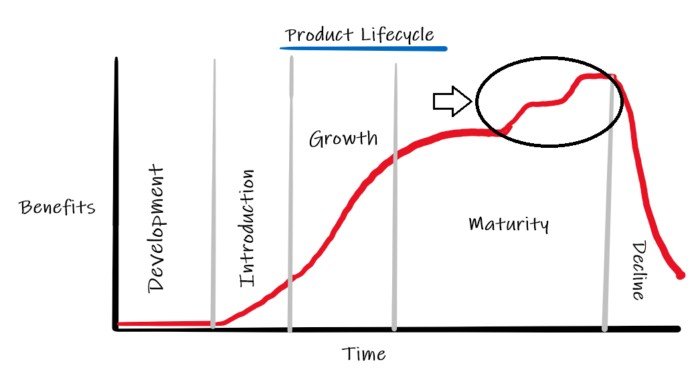
Every product has its time of death, which could begin immediately after launch or in 50 years, depending on the project team’s ability to effectively answer the question “What can go wrong?” while anticipating consumer and market reactions. Understanding the normal product life cycle of any innovation, as well as the stage of your product, may allow you to prolong its demise through timely relaunches or interventions, as seen in Figure 1. In addressing the failure of a product, I have given a few items to consider in delaying the death of your product and allowing it to linger longer in the consciousness of your intended user from the perspective of an R&D scientist:
1. Consumer understanding:
Every successful product needs a user, irrespective of their location, the language they speak, or the colour of their skin. Consumer understanding sits at the core of your brand’s longevity and relevance. Every creator should be able to answer the question, “Who are my consumers?” “Where can I find them?” “What are their habits?” “What are their pain points?” and lastly, “What is their dealbreaker?”
2. Product positioning:
The placement of your products must correspond to the location of your customers. In the process of providing an answer to the question “Where can I find my consumer?” you will be able to locate them and further satisfy the needs that they have.
3. Formulation Design:
The overall look of your product attracts your type of target consumers. We are currently in an era where attention spans are shorter (between six and ten seconds), and they will even get shorter as we progress towards an era that is predominantly driven by technology. When designing a product, the demographics and behaviours of the target market are taken into consideration. For instance, if I were to design a product for a new mother in West Africa who bathes her baby while sitting on a stool, as opposed to a mother in a developed country who bathes her child in a bathtub, my approach to formulation design would be different between the two scenarios. Some characteristics may be shared, such as slippery hands, damp hands, and uncompromised care, while other factors remain distinct, such as the climate, culture, and skin needs.
4. Packaging design:
I have witnessed amazing ideas fail as soon as they are introduced to the market because they are packaged incorrectly. Imagine the amount of effort and resources that are dedicated to the process of launching a product on the market. The fact that the customer does not pick up and make a return purchase, on the other hand, renders all of that entirely irrelevant. For instance, a lotion in a jar, thin liquids, or oil in a jar are all examples of products that are doomed to fail and will result in tears. A good product that is packaged incorrectly will always fail. When seen from a holistic perspective, the product may be excellent and one of a kind, but the presentation of the packaging is incorrect and makes the product burdensome to the user.
The secret to this is understanding consumer behaviour around the need statement—answering. If you can answer the question, “How do my customers behave around this packaging?” you will be able to design packaging that is suitable and fit for purpose.
I sincerely hope that you have found this reading to be as beneficial as I had hoped it would be, and I excitedly anticipate hearing your thoughts and contributions.
Keep in mind that I am still operating a business that provides R&D outsourcing services in Nigeria and throughout major African markets. Please get in touch with us as soon as possible for your research and development needs, and my team would be delighted to hear from you.
In the meantime, until we meet again, “Be Courage.”

Disclaimer: Blogs and media platforms should email office@lolavalor.com for reposting, licencing, or credit. Sharing part or all of this article is permitted when duly credited. Thank you