
Here is what it means for formulators and beauty manufacturers.
If you work with shea butter, whether you are formulating skincare, sourcing raw materials, or manufacturing finished goods, this week’s policy announcement deserves your attention.
President Bola Tinubu has extended Nigeria’s ban on the export of raw shea nuts for another year, effective February 26, 2026, through February 25, 2027. On the surface, it reads like a trade regulation update. For anyone in the beauty and personal care industry, it is something more specific: a structural signal about where Nigeria’s shea supply chain is headed and what that means for the people building products with it
What the Policy Actually Does
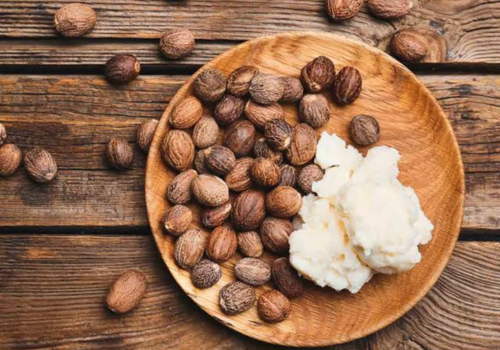
The ban prevents shea nuts from leaving Nigeria in their raw, unprocessed form. Exporters cannot ship the nut itself; only processed derivatives qualify for export. That means shea butter, shea stearin, shea olein, and other refined fractions. Raw nuts must stay onshore and move through local processing before they can enter global trade.
To enforce this, President Tinubu has ordered the immediate withdrawal of all previously granted waivers that allowed some exporters to bypass the ban. Going forward, any surplus raw nuts that cannot be absorbed domestically must be exported exclusively through a framework developed by the Nigerian Commodity Exchange (NCX), under approved guidelines.
The Federal Ministry of Industry, Trade, and Investment, working alongside the Presidential Food Security Coordination Unit, has been directed to build a unified national framework that aligns trade, investment, and industrialisation priorities across the entire shea value chain. A dedicated financing window through the Federal Ministry of Finance will also be opened to pilot a Livelihood Finance Mechanism aimed at boosting both production and processing capacity.
In short, more nuts staying onshore, more processing happening domestically, and a more structured system governing how the commodity moves.
Why the Numbers Make This Policy Make Sense
Shea trees grow predominantly across Nigeria’s savanna belt, one of the largest shea-producing zones in the world. For decades, a significant portion of that harvest left the country as raw nuts, with the value addition happening elsewhere: in European refineries, in Asian processing facilities, in factories far from the communities that did the harvesting.
The Federal Government’s own figures put the gap in stark terms: processed shea butter commands between 10 and 20 times the price of raw nuts on international markets.
That multiple is not abstract for a formulator. It is the difference between Nigeria capturing $0.50 per kilogram of commodity and capturing $8 to $15 per kilogram of finished ingredient. Multiplied across hundreds of thousands of tonnes of annual production, the economic case for domestic processing is not subtle.
For the beauty industry specifically, shea butter’s value proposition is well established. It is a staple emollient in body butters, hair creams, baby care formulations, lip products, and skin-barrier repair systems. Its fatty acid profile, particularly its high stearic and oleic acid content, gives it exceptional skin-feel and moisturization properties that synthetic alternatives rarely replicate well. Refined shea is used in mainstream cosmetics. Unrefined shea carries a loyal market in natural and clean beauty. Both forms command serious demand globally, and Nigeria sits on one of the world’s most significant natural reserves of the raw material.
What This Means If You Are Formulating or Manufacturing
For Nigerian-based manufacturers and formulators, the most immediate implication is access. With more raw nuts staying in the country and more processing infrastructure being incentivized, the domestic supply of processed shea should in theory, become more consistent and more competitively priced over time. If the financing mechanisms the government is establishing reach processors meaningfully, capacity in the sector could grow in ways that benefit downstream buyers.
The NCX framework, if it functions as intended, also introduces more structure into a supply chain that has historically been fragmented. Better traceability, more standardised grading, and clearer commercial pathways between producers, processors, and buyers are all outcomes a well-implemented commodity exchange framework can support.
For brands sourcing Nigerian shea internationally, the ban makes it harder and eventually impossible to access raw nuts directly. Procurement now routes through processors by design. That is not necessarily a disadvantage: working with a properly processed, graded product reduces variability and simplifies quality management on your end. But it does mean supplier relationships and sourcing strategies may need to be reviewed, particularly if any existing agreements were structured around raw material imports.
For indie formulators and small beauty brands, this is a longer-term signal worth watching. Policies that build domestic processing capacity tend to, over time, create a more accessible local supply. If you are a Nigerian brand currently paying a premium to source processed shea butter, sometimes reimported after being exported raw and refined abroad, a strengthened domestic processing sector should eventually translate into better pricing and easier access closer to home.
The Bigger Picture
Nigeria is not the only country rethinking how it participates in the shea value chain. Across West Africa, there has been a growing policy push to retain more agricultural processing domestically to move up the value chain rather than export raw commodities and buy back finished products at a significant markup. Ghana, Burkina Faso, and Mali have all implemented various measures in this direction.
What makes Nigeria’s approach notable is the structural scaffolding being built around it: the NCX framework, the interministerial coordination, the financing mechanisms, and the withdrawal of waivers. These are not the hallmarks of a symbolic policy. They suggest an administration that intends the ban to hold and to generate measurable outcomes.
Whether implementation matches intention is a separate question and one the industry will be watching closely over the next twelve months.
What to Watch
- NCX framework rollout: How the Nigerian Commodity Exchange operationalises the export guidelines will determine how smoothly the new system functions for processors and buyers alike.
- Processing capacity growth: Whether the Livelihood Finance Mechanism genuinely reaches processors, particularly smaller-scale operators in shea-producing communities, will affect how much supply actually enters the domestic refined market.
- Pricing movements: As more nuts move through domestic processing rather than raw export, watch for shifts in local processed shea pricing over the next two to three quarters.
- Waiver enforcement: The cancellation of existing waivers will be tested. How rigorously this is enforced will signal how seriously the administration intends to hold the policy’s terms.
Our Take at Lola Valor
We are not here to tell you whether this policy is good or bad. That is a conversation for economists and policymakers. What we can tell you is what it means for the decisions you need to make as a formulator or brand owner and where we think your attention should go.
First, on pricing and supply: do not wait to feel the effects before you respond to them.
The transition from a fragmented raw-nut export market to a more structured domestic processing system does not happen overnight, and it will not be smooth in every direction. In the near term, as waiver holders lose their exemptions and the NCX framework finds its footing, there may be supply disruptions and pricing volatility at the processed-butter level. If shea butter is a significant ingredient in your formulations, now is the time to review your supplier contracts, understand your lead times, and consider whether your current stock levels give you enough runway to absorb short-term fluctuations without having to reformulate under pressure.
We are not predicting a crisis; we are saying that supply chain awareness is part of formulation discipline, and policies like this one are exactly the kind of upstream event that catches brands off guard when they are not watching.
Second, on local supply chains: this is the moment to take them seriously.
For years, one of the quiet frustrations in the Nigerian beauty manufacturing space has been the paradox of sourcing shea. Nigeria produces enormous quantities of it. And yet many brands, including small and mid-sized ones, have found themselves sourcing processed shea butter that left this country as a raw nut, was refined abroad, and returned at a price that reflected someone else’s value addition. That has always been a structural problem; this policy, if implemented with consistency, begins to address it. More domestic processing means more locally available refined products. The brands that build supplier relationships with Nigerian processors now, before the market fully restructures, will be better positioned than those who wait to see how it plays out.
We encourage every brand and formulator in our community to map their shea supply chain. Know where your butter comes from, who processed it, and what your alternatives are. That is not paranoia. That is the kind of raw-material intelligence that separates brands that scale from those that stall when conditions shift.
We will be watching how this develops and sharing what we learn.
In the meantime, if you have questions about how this might affect your specific formulation or sourcing situation, send us an email at office@lolavalor.com
For formulators and beauty industry professionals, the headline is this: Nigeria is deliberately building the infrastructure to become a more significant exporter of processed shea, not just raw material. This is a direction the industry should understand, track, and, where possible, engage with.
The shea in your product has always come from communities in Nigeria’s savanna belt. The question this policy is asking and answering is where the economic value of that shea is captured. Increasingly, the answer is intended to be: here, before it leaves.